GameDev studio DeusCode Classic — a pipeline of indie games for Steam
The investor package is exactly 30 indie games in the highest-grossing genres — card roguelike, RTS and more. Exactly 30, no more, no less: the lifetime profit share is calculated on precisely these titles. Our in-house AI asset factory, the Forge, assembles a game in days, not months; the first titles are already in builds.
What the abbreviations on this page mean▾
Investor decks love acronyms — here are the ones used below, spelled out.
- wishlist
- — a Steam wishlist — intent to buy at launch, the key pre-release signal
- NextFest
- — Steam Next Fest — the demo festival, the main free traffic for indies
- ASP
- — Average Selling Price per copy
- reviewRatio
- — share of positive Steam reviews — drives visibility and sales
- refundRate
- — share of refunds (Steam allows them under 2h played / 14 days)
- netMargin
- — profit after all costs, as a % of revenue
- postMoney
- — company valuation after the round is raised
- conversion
- — share of visitors who become buyers
What's already built — in frames
Not concept art, but live builds and the studio's real assets.
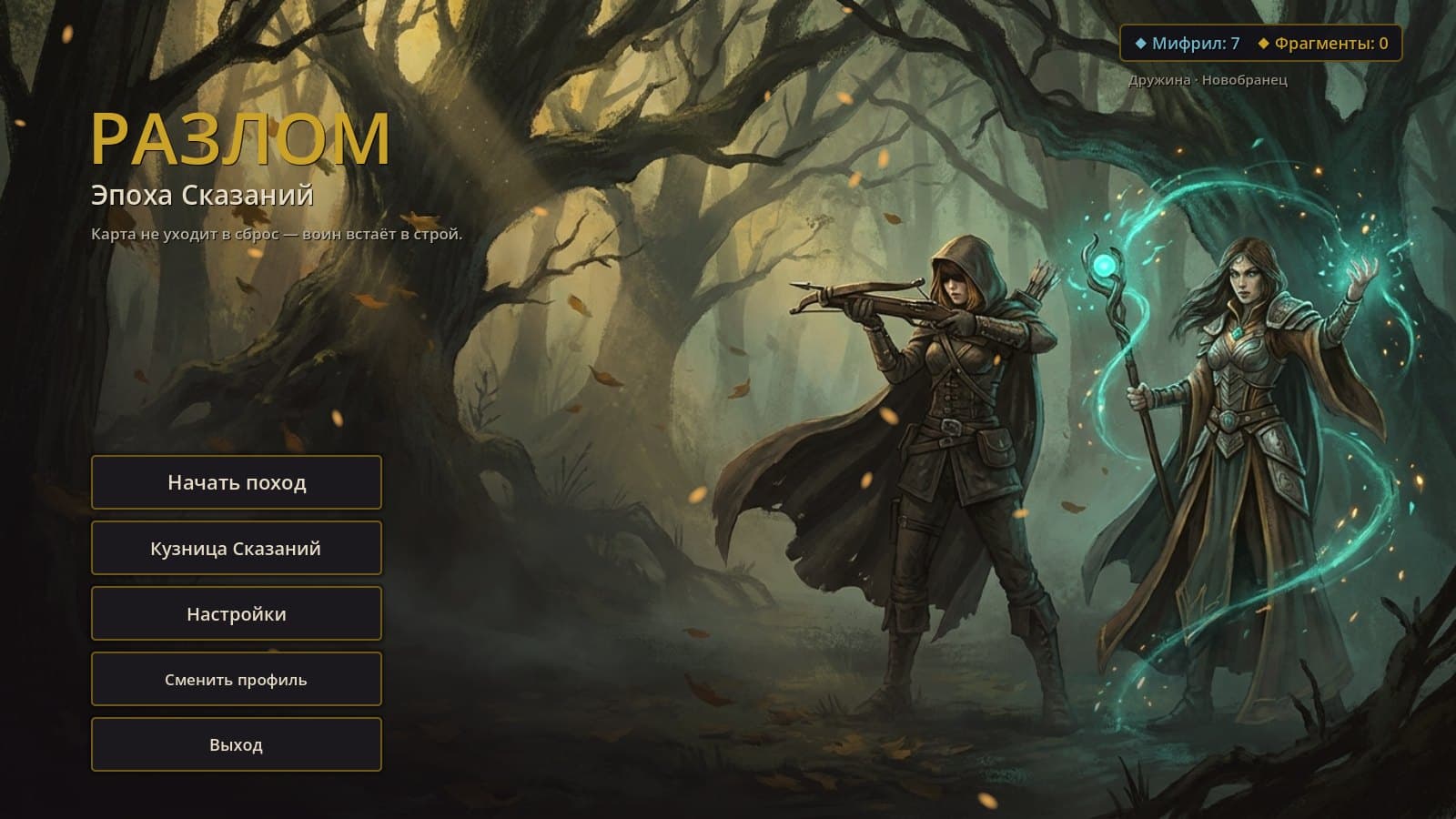
Card roguelike «Rift: Age of Legends» — key screen: the huntress and the seer, a living menu.
The screenshots below are from real builds: a card roguelike and an isometric RTS, plus renders and the Forge pipeline.
What already works
This isn't a presentation of the future — these are builds you can run today.
- ✦A card roguelike with a full combat engine: 3 locations, bosses with their own mechanics, a 3-slot ability system, Forge meta, localization into 10 languages.
- ✦A balance simulator: thousands of automated runs tune each game's economy before release — a rarity even among larger indies.
- ✦An isometric RTS: playable squad battles, resource economy, building and unit renders.
- ✦The Forge — our own AI asset factory (CC0 base + adaptation + generation with an honest declaration on Steam): a single small team ships a game in days.
- ✦A ready-made YouTube/TikTok content engine: auto-cut shorts and publishing — the same one already running the studio's channels.
- ✦The first titles are at the ready-to-launch stage.
Why indie and why now
The roguelike genre keeps producing hits that outperform their budgets many times over — but the market median is brutal. The answer to that is a portfolio, not a single bet.
Roguelikes have taken over Steam
Balatro (2024), a card roguelike made by one person, sold 5M+ copies in about a year and contended for Game of the Year. Hades passed 1M copies within days of its 1.0 release; Vampire Survivors sold millions. The genre keeps producing million-sellers — a rare but real outcome, and the portfolio gives us 30 shots at it.
The median is the honest truth
The top is not the median. The average indie game on Steam sells only a couple of hundred copies. That's exactly why the plan is a portfolio of 30 games rather than a single title: a portfolio turns "most indies are small" from a risk into the base rate we diversify around.
Our edge is cost
The Forge collapses indie's biggest cost line — art and time. A game comes together in days. At that cost, even modest sales of a title are profitable, and a single hit pays for a dozen.
What we'll add after the round
AI-amplified marketing: a constant stream of YouTube/TikTok shorts linking to the studio's Steam page, paid integrations with genre bloggers in multiple languages, AI-run Google/Yandex ads pointing to a dedicated games landing with a built-in AI consultant, AI outreach to themed communities, and placements in Telegram channels of 500k–3M subscribers.
The launch mechanics for each game
The same proven route for every title — from the Steam page to measuring the first month of sales.
| 1. Steam page | start | We build the title's store page and accumulate wishlists. |
| 2. Steam registration | 2–3 days | App review and admission to the store. |
| 3. Demo month | ≈30 days | Steam's "freeze" / a Next Fest window — the demo builds wishlists ahead of release. |
| 4. On sale | release | The title goes on sale at $12.99. |
| 5. First month | measurement | The window for measuring the title's real numbers — the basis for decisions. |
The round and the share calculator
The price is fixed: $15,000 per 1%. Entry from 10% ($150,000) to 20% ($300,000), in 1% steps. Move the slider — you'll see your cheque, your annual share of profit, the multiple and the payback period in each scenario. These are models on stated assumptions, not a guarantee.
The share is lifetime, of the net profit of these game projects. The valuation is fixed because the price per 1% is constant; several investors can join the round on equal terms.
What the share returns per year — by scenario
Model: Steam takes 30%; after refunds, fees, taxes and lean operations, the net margin is ≈38% of gross sales.
⏱ Payback is counted from month 3: the first titles are already done, but Steam's demo freeze and promoting the first wave take ~2 months to reach first revenue.
Scenarios are the 30-game package's gross sales for the year: minimum plan — 1,500 copies per game, average — 3,500, strong — one 100,000-copy hit plus 29 games at ~2,000 each (158,000 copies total). Every title ships in 10 languages and sells in the countries of those languages. Million-copy runs (Balatro: 5M+ in a year) are not built into the model — upside on top.
The super prize: a shot at 2 million copies
This is what the pack of cashable, Forge-friendly genres is built for. It is the goal, not the base case.
🏆 The pack's goal — 2,000,000 copies
30 games in 10 languages across 10 countries. If the pack in total — or even a single game — reaches 2M copies sold (still below Balatro's 5M+ from one project in a year), the turnover is 2,000,000 × $12.99 ≈ $25.98M. Net profit at the ≈38% margin is ≈$9.9M: a 10% stake earns ≈$990k, 20% — ≈$1.97M over the achievement window.
↩ Principal back at the minimum plan
A special deal term: if all 30 games reach the minimum plan (1,500 copies each) within the first period, we return the investor's principal out of shared profit — and the purchased stake stays theirs for life, continuing to earn from all further sales.
The Forge — an asset factory
Our own AI pipeline, which already built the games shown above. It's the very reason a title's cost is a fraction of a normal studio's.
From text to an in-game object
Buildings, units, backgrounds: concept render → baked into a 3D model with an in-game texture. What takes studios weeks, the Forge does in hours.
An honest base and declaration
Source priority: CC0 → adaptation of free assets → generation with an open AI declaration on Steam. Key art goes through manual finishing by an artist.
Proven on live games
Backgrounds, floors, key art and the card roguelike's carousel, the RTS building renders — all of it was already built by the Forge, not bought with budget.
Scales across 30 games
One pipeline feeds the whole line: the more titles in production, the cheaper each next asset.
Marketing after the round
The investment turns on a content machine the studio has already road-tested on itself.
AI sales assistant
24/7Handles inbound flow, answers on the facts, brings a warm lead through to a manager — the same engine that runs these investment pages.
Advertising the whole pack
from revenueSales revenue is reinvested into paid marketing: we advertise the whole 30-game pack as a studio, not each game separately. The bigger the round, the stronger the marketing for all 30 at once.
YouTube/TikTok shorts
constantRegular auto-cut clips for every title, published on schedule — every video links to the game and the studio's Steam page. Free organic traffic for each release.
Paid blogger integrations
paidPaid integrations with gaming bloggers dedicated to exactly our genres — in multiple languages, around every notable release.
Google & Yandex ads
AI-runAI sets up and runs targeted Google and Yandex campaigns pointing to a dedicated landing about our games — with links to the titles and a built-in AI consultant.
AI community outreach
targetedAI-driven outreach to themed groups and precise targeting of the genre's audience — interest-based, not spam.
Telegram placements
500k–3MPaid placements in Telegram communities of 500 thousand to 3 million users.
Studio storefront on Steam
cross-salesThe Steam developer page gathers every game under one brand: whoever buys one game sees the other 29 tomorrow. Every new release advertises the whole catalog.
Next Fest and wishlists
at releaseDemo windows and Steam festivals build wishlists ahead of launch — the main free traffic source for indies.
The catalog's long tail
ongoingEvery released game keeps selling during sales events; a growing catalog is cumulative revenue, not one-off spikes.
Key metrics of the model
The benchmark figures the round's financial model is built on.
No more, no less: the investor's lifetime share is calculated on precisely these 30 titles.
Cruising release frequency on the Forge pipeline.
Average sale price of a copy on Steam.
Minimum plan and average sales target per title — the model's base, not a guarantee.
Strong scenario: one title breaks out to 100k while the rest hold ~2k — 158,000 copies in total.
Every title is localized into 10 languages — sales run across those countries, not one market.
After Steam's 30%, refunds, taxes and operations.
Fixed; portfolio valuation — $1.5M post-money.
Risks — honestly
⚠Indie visibility
Risk: Most titles sell modestly; the Steam median is a few hundred copies.
How we solve it: A 30-game portfolio instead of one bet, a studio storefront with cross-sales, paid genre-blogger integrations and a constant shorts stream — every title gets traffic, and hits pull the catalog.
⚠AI assets & disclosure
Risk: Steam requires AI-content disclosure; part of the audience is sensitive to AI art — a risk for reviews.
How we solve it: A CC0 base, hand-finishing of key art, honest disclosure on every page — and a focus on gameplay: the genre forgives simple art when the game plays great.
⚠Release cadence
Risk: Keeping a release every 3-4 days without losing quality is the main operational bet.
How we solve it: The Forge pipeline already assembles assets in hours; it is proven on the first builds, and titles go in waves — one delay does not stop the rest.
⚠Steam dependency
Risk: A single distribution channel: rule changes or review delays hit the schedule.
How we solve it: Pages are registered in advance (2-3 days), demos a month ahead, releases run as a pipeline — one shifted window does not break the wave; other stores (Itch.io etc.) can be added.
⚠These are models
Risk: Projections rest on stated assumptions, not booked revenue.
How we solve it: We repeat this next to every figure; the public first-month measurement of every title checks plan against fact, and the model is corrected with real data.
Enter a portfolio of indie hits
A lifetime share of the net profit of 30+ games for Steam. The first titles are ready to publish — the round turns on marketing, cadence and the catalog.
All financial figures are models based on stated assumptions, not a promise of returns. Investing in game development carries the risk of total loss of the amount invested. This material is informational and does not constitute a public offer or investment advice.