
A messenger that works without a VPN where the others no longer do
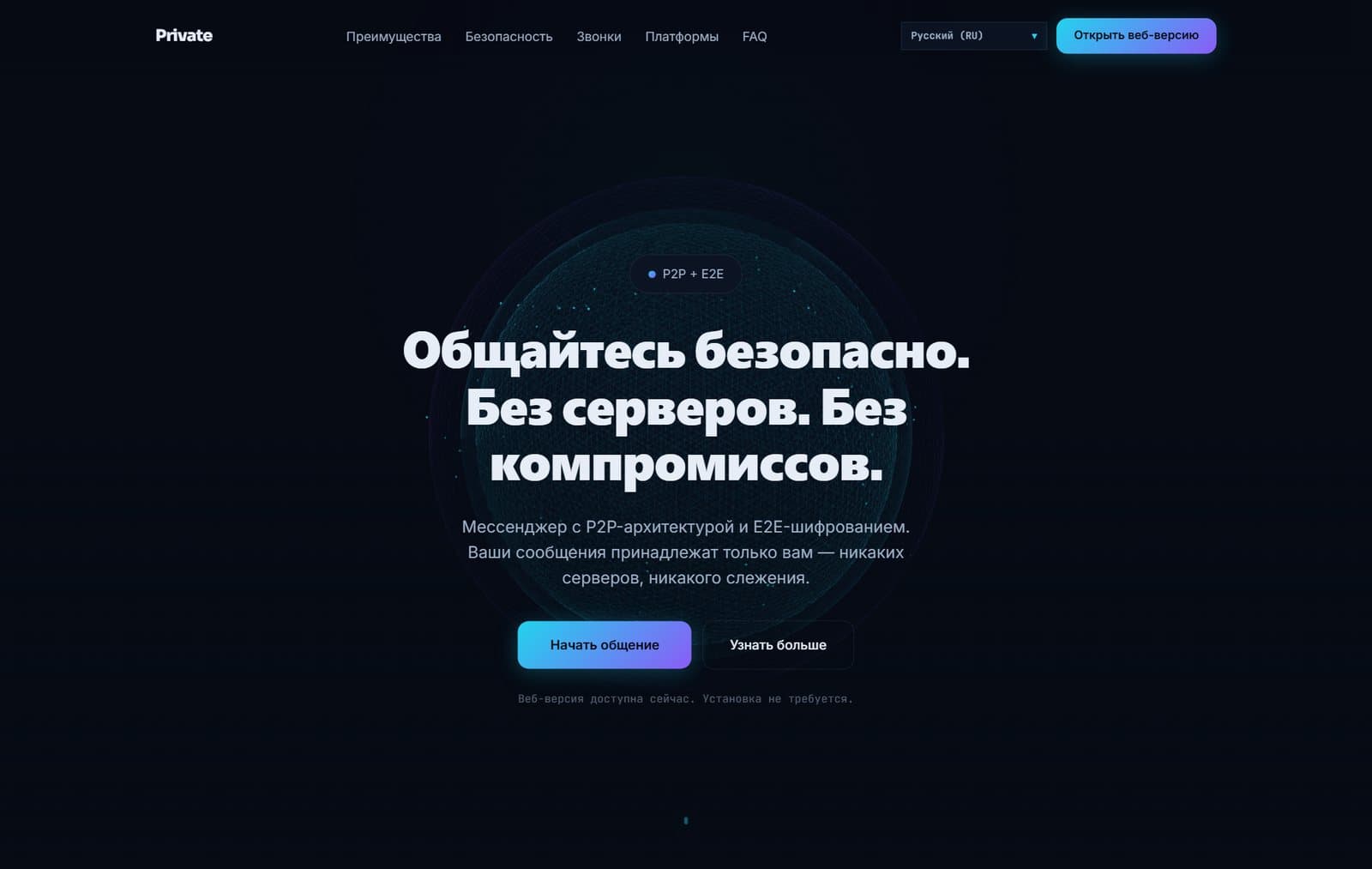
Private is a P2P messenger with end-to-end encryption: messages travel directly between devices — no phone number, no email, no app stores. The product is already in production — open it and message someone right now.
What the abbreviations on this page mean▾
Investor decks love acronyms — here are the ones used below, spelled out.
- MAU
- — Monthly Active Users — unique users in a month
- DAU
- — Daily Active Users — unique users in a day
- ARPU
- — Average Revenue Per User
- ARPPU
- — Average Revenue Per Paying User
- LTV
- — Lifetime Value — total a customer brings over their lifetime
- churn
- — share of customers lost over a period
- conversion
- — share of visitors who become buyers
- netMargin
- — profit after all costs, as a % of revenue
- postMoney
- — company valuation after the round is raised
What already works
The product is finished and working. And straight to the honest part: we have not advertised it yet — only testers are on it today and monetization is not switched on. This round funds the large-scale advertising campaign and the infrastructure to carry it, not development.
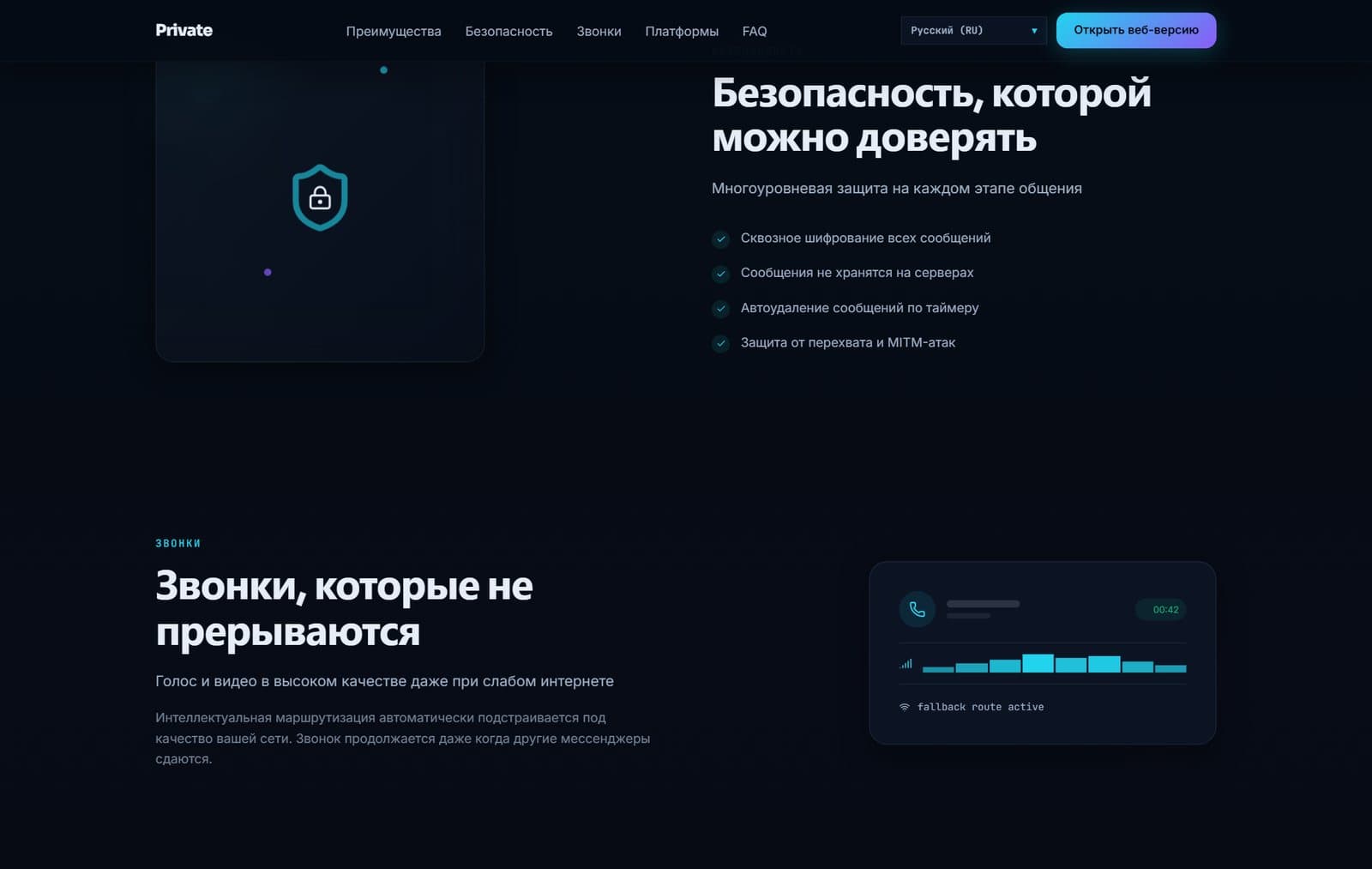
- ✦P2P architecture: messages go directly between devices with no central storage node — no single point of compromise
- ✦End-to-end encryption on every message; timer-based auto-deletion; protection against interception and MITM attacks
- ✦Voice and video calls with smart routing — they survive weak networks
- ✦Sign-in without a phone or email: just a login and a key, recovery via a 12-word seed phrase
- ✦Web version with no install + PWA for Android and iOS
- ✦All of the above is live on pri-vat.chat: it opens and works right now
Why now
The window in Russia is open
MAX does not solve cross-border communication, while foreign messengers increasingly require a VPN.
Everyone has someone abroad
1–10 relatives, friends or colleagues in another country — a daily need, not an edge case.
A messenger is viral by nature
To solve their own problem, a user must bring the other side. Every closed pair is at least two users.
Three barriers removed at once
No VPN, no phone number, no app store — entry straight from the browser.
The market, by the numbers rather than by feel
We are not competing with Telegram for its billion. We are looking at the fact that this billion is barely monetized, and that cross-border communication in our region is broken. The 10M MAU scenario is 1% of today's Telegram — a waypoint, not a ceiling.
The size of the category. It was 950M a year earlier — still growing
15M subscribers as of May 2025: the category monetizes about one user in seventy
Telegram's second-largest market, ~51% population penetration
The highest in the world against a ~4-hour global average
The round: up to 20% at $50,000 per 1%
The investor receives a share of the project's net profit. Minimum entry is 5% for $250,000, the maximum in this round is 20% for $1,000,000, in 1% steps. Suggested entry: 10% for $500,000. Move the slider to see your cheque and your return.
1% increments. The per-percent price is fixed, so the valuation is identical at any cheque size — and so is the multiple on your money: the stake changes the amount, not the rate of return. Several investors can join on equal terms.
What your stake returns
Calculated at a 35% net margin on revenue — a modelled assumption after infrastructure, marketing, team and payment fees. VIP's AI translation runs on the user's own key, so it never enters our cost base.
⏱ Counted from the round closing: the first 3 months go into infrastructure and campaign preparation, then 1–2 months while the advertising ramps up and builds an audience. No revenue exists before that point. At month 5 we take a metrics reading, fix the actual cost lines and net profit, and discuss marketing strategy, budget and possible expansion into new markets on real data rather than assumptions.
All three scenarios are models, not forecasts or guarantees, and they describe the company 1–5 years out, not today's. Today this is a production-grade product that has never had a dollar of advertising, priced at $5M post-money; the gap between those two pictures is the whole investment thesis. Venture return normally comes from growth in the value of the stake as well as from profit distribution.
Where the money goes
The spending list is the same at any cheque size — only the scale changes. Less money means the same plan at a smaller reach: fewer relay regions and narrower marketing. More money means more advertising and more TURN nodes worldwide.
| Round | Infrastructure | Marketing | Product & team | Reserve |
|---|---|---|---|---|
| $250,000 · 5% | $80,000 | $100,000 | $50,000 | $20,000 |
| $500,000 · 10% | $150,000 | $210,000 | $95,000 | $45,000 |
| $1,000,000 · 20% | $250,000 | $500,000 | $180,000 | $70,000 |
Infrastructure means the TURN/STUN relay network, geo-distribution and failover. It is not an optional line: a P2P messenger still needs relays wherever a direct connection cannot be established.
Roadmap after the round closes
| Round closes | Month 0 | Funds in the account, plan and tranches fixed |
| Infrastructure and preparation | Months 1–3 | Deploy the TURN/STUN relay network across regions, load-testing and failover; switch monetization on ($2 base subscription, Premium, VIP, advertising); build creatives, landing pages and the referral engine |
| Advertising campaign launches | Month 3 | No users appear before this point — that is the honest sequence, not cautious wording |
| Building the base | Months 4–12 | Target: scenario A — 1M MAU, the referral loop running, first corporate clients |
| Scaling | Years 2–5 | Scenarios B and C: 5M and 10M MAU; the corporate line becomes a second revenue engine |
Monetization: five streams
The foundation is a $2/month base subscription paid by every user: predictable revenue from day one, independent of conversion. Premium, VIP, advertising and the corporate line come on top. None of the streams is switched on yet — all are designed and waiting for a user base. The round buys distribution for a product that is already built.
Base subscription · everyone
$2 / moEvery user pays $2 a month for the service itself. Why it works: cheap — cheaper than any VPN, and no VPN is needed; connectivity without outages or blocking; full anonymity — no phone, no email, no profile. $2 is a price nobody argues about, and the base subscription delivers predictable revenue from day one regardless of whether the user ever buys Premium.
Premium
$9 / mo · $7 quarterly · $5 annualMultiplied file-upload speed and data-transfer volume, higher call quality, the entire current feature set and a unique premium profile frame. Quarterly billing brings the month to $7, annual to $5. In the model: $7.2 average revenue per subscriber per month (the price mix net of free periods handed out by the referral programme), at 5% conversion against Telegram's ≈1.5%.
Advertising · B2B
≈$1.5 CPMSponsored posts in groups shown to all users without Premium or VIP, and to all users in partner channels. Priced on the Telegram Ads model: ≈$1.5 CPM, ≈28 impressions per user per month. Premium and VIP users see no ads — the streams reinforce each other.
Corporate messenger · B2B
$10,000 + subscriptionA white-label edition under the client's brand, domain and PWA app, for companies from 30 employees. The company's admin grants access and can trace file and message movement inside — for organisations that need control over their digital turnover.
VIP
$100 / moEverything in Premium plus a professional real-time AI translator: incoming messages are translated into your language, your outgoing messages into your counterpart's (in groups and channels, incoming only). The key design decision: the user plugs in their own OpenRouter API key, picks their own model and translation rules, and can attach their own AI. So inference cost never touches our P&L, and the user pays for exactly the quality they need and controls it themselves. Plus a business AI you can attach to a chat so it answers customers about your product.
Corporate messenger out of the box
White-label for companies from 30 employees: their brand, their domain, their PWA app. The difference from the consumer version — the company's administrator grants access and can trace file and message movement inside. Built for organisations that need control over their digital turnover.
Integration — $10,000 one-off
Launch, server, domain, database integration, admin panel and the first 3 months of hosting are included. From month 4, a subscription based on headcount. Annual prepayment: −20%; monthly billing carries no discount.
| Employees | Per month | Per year (−20%) |
|---|---|---|
| up to 50 | $300 | $2,880 |
| up to 75 | $420 | $4,032 |
| up to 100 | $540 | $5,184 |
| up to 250 | $1,100 | $10,560 |
| up to 500 | $1,900 | $18,240 |
| up to 1000 | $3,200 | $30,720 |
| 1001+ | Custom | Custom |
Infrastructure for a 1000-seat deployment costs $70–90 a month — gross margin on every tier stays above 90%. Pricing is value-based rather than cost-plus: control over digital turnover is worth far more to a company than a server.
The referral programme — the growth engine
A messenger already forces the invite: without the other side, the product is useless. The referral ladder makes that invite pay — and it brings the right people rather than random traffic.
| Condition | Reward | Cost to us | CAC per user |
|---|---|---|---|
| 5 users invited | 7 days of Premium free, one-off, activated by the user themselves | ≈$2.10 | ≈$0.42 |
| 30 users invited | One month of Premium free | ≈$9 | ≈$0.30 |
| 1000+ · blogger quest | One year of Premium free + 10% cashback on everything their referrals buy | ≈$60–108 + 10% of that pool's spend | ≈$0.06–0.11 |
Paid traffic costs $0.8–2.5 per user. The referral ladder costs a fraction of that — and it delivers the exact counterpart the user joined to reach. Every user who arrives pulls 2–5 more in from abroad.
Revenue scenarios by MAU
Three scenarios by size of the active base, each with the horizon it belongs to. 10M MAU is 1% of today's Telegram — a waypoint rather than a ceiling.
| Stream | 1M MAU | 5M MAU | 10M MAU |
|---|---|---|---|
| Base subscription ($2 × MAU) | $2,000,000 | $10,000,000 | $20,000,000 |
| Premium (5% × $7.2) | $360,000 | $1,800,000 | $3,600,000 |
| VIP (0.5% × $100) | $500,000 | $2,500,000 | $5,000,000 |
| Advertising ($1.5 CPM) | $39,700 | $198,500 | $396,900 |
| Corporate subscriptions | $12,600 | $62,400 | $150,000 |
| Total per month | $2,912,300 | $14,560,900 | $29,146,900 |
| Annual run-rate | $34.95M | $174.7M | $349.8M |
A model, not a fact. Assumptions: every active user pays the $2/month base subscription; 5% Premium conversion at $7.2 average revenue per subscriber, 0.5% VIP, ≈28 ad impressions per user without Premium/VIP per month at $1.5 CPM, corporate clients growing with the base. Corporate integration fees ($10,000 each) come on top of these figures.
Sensitivity: what happens if conversion comes in lower
We model conversion above the category benchmark and we are not hiding it. Here is the same 1M MAU base at three conversion levels. The $2 base subscription, advertising and corporate subscriptions are identical in all three columns — ≈$2,052,300 a month.
| Case at 1M MAU | Premium | VIP | Revenue / month | Per year |
|---|---|---|---|---|
| Conservative | 2% | 0.15% | $2,346,300 | $28.16M |
| Base | 3.5% | 0.3% | $2,604,300 | $31.25M |
| Target | 5% | 0.5% | $2,912,300 | $34.95M |
The argument is the conservative column, not the target one: even at conversion barely above Telegram's own 1.5%, the project clears $28M a year on a 1M MAU base. The $2 base subscription makes revenue almost insensitive to Premium conversion.
Key metrics
No campaign has been run yet, so there are no actual base metrics — there is simply nothing to measure before launch. Below are the model's targets: these are the numbers the project will be judged on once the campaign starts.
Cheaper than any VPN, no blocking, fully anonymous — 100% of the active base pays
Stickiness — normal for a messenger people use every day
2–5 invites per user × 30–50% acceptance. A messenger is the rare product where the user must bring the other side
A messenger is a habit, not a session
Telegram converts ≈1.5% at around $4. We model more: Premium sells speed and volume, and the product works where Telegram needs a VPN
A business audience: people whose working correspondence crosses a border
Blended across all streams, 1M MAU scenario
Against $0.8–2.5 per user on paid traffic
$70–90 of infrastructure per 1000 seats
Technology
The public level — exactly enough to understand the architecture and judge the risks.
P2P transport
Direct connections between devices; message content never passes through our servers and is stored nowhere.
End-to-end encryption
Keys stay on the device; access is restored from a 12-word seed phrase.
TURN/STUN relay network
The fallback for when a direct connection through NAT or a firewall is impossible. This is the infrastructure the round funds.
Geo-distribution and failover
A regional outage does not take the network down; calls survive weak and hostile networks.
PWA for Android and iOS
No app-store gatekeeping: instant updates, install straight from the browser.
No phone, email or profile
Nothing to leak: personal data is simply never collected.
🔒 Implementation details, the protocol and the cryptographic scheme are not disclosed publicly — a technical session is held with the founder under NDA.
Risks — named honestly
⚠The product has never been advertised
Risk: The messenger works, but there has been no campaign: only testers use it now, monetization is off.
How we solve it: That is exactly what the round funds: the money goes into large-scale advertising and the relay infrastructure behind it, not into development.
⚠Conversions above the market benchmark
Risk: We model 5% into Premium against Telegram's ~1.5% — and we do not hide it.
How we solve it: The sensitivity table above: even the conservative column, with conversion just above Telegram's, yields over $28M a year on a 1M-MAU base — the $2 base subscription carries most of the revenue.
⚠Network effect
Risk: A messenger is useless if your contacts are not on it.
How we solve it: The cross-border pain forces invitations: people arrive in clusters — family, friends, work chats — not one by one.
⚠Relay costs grow with load
Risk: Calls are the most expensive traffic; as the base grows, so do relay bills.
How we solve it: P2P-first: relays are only a fallback, and Premium monetizes precisely the heaviest users — the load pays for itself.
⚠Regulatory pressure
Risk: End-to-end encrypted messengers face growing regulatory attention.
How we solve it: No personal data is collected, distribution goes through a PWA outside app stores, and the corporate line does not depend on consumer regulation.
⚠Competing with free giants
Risk: WhatsApp and Telegram have billions of users and a free product.
How we solve it: Where they have scale, either cross-border connectivity fails for this audience or a VPN is required. Private's whole wedge is 'it just works'.
Ready to discuss joining the round?
Open the messenger, put any question to the AI consultant on this page — then go straight to the founder. Terms, tranches and the shareholders' agreement are discussed in person.
All forward-looking figures are model estimates and not a guarantee of returns. Technical implementation details are disclosed under NDA.