
Terrania — an agentic AI system desktop + web for enterprise
An autonomous AI operator: 84 tools across 16 domains, local models on your own hardware, full machine control, pentest audits and media generation. For enterprises, pentesters, B2B and private security agencies. The round: $39M for 30% — a lifetime share of net profit, entry from 0.2% ($260,000).
本页缩写的含义▾
投资资料常用缩写——以下为本页所用术语的解释。
- KYC
- — 了解你的客户——法律要求的身份核验
- B2B
- — 面向企业而非消费者的销售
- SaaS
- — 软件即服务——按订阅提供的云软件
- seat
- — 单用户席位许可
- ARR
- — 年度经常性收入(订阅)
- MRR
- — 月度经常性收入(订阅)
- churn
- — 流失率——一段时间内流失的客户比例
- netMargin
- — 净利率——扣除全部成本后的利润占收入比例
- postMoney
- — 融资后公司估值
- TAM
- — 潜在市场总额——整个市场的货币规模
Who it's for
Not a cloud chatbot — an autonomous operator on your own hardware, from enterprise security to gamedev and content production.
Enterprises
Local models on your hardware: data never leaves the perimeter. Full control of the PC, code, infrastructure and browser from one system.
Pentesters
Non-destructive security testing + auto-generated report with OWASP findings, severities and remediations.
B2B & SaaS
Routine automation: code audit, SSH, Git ops, RAG memory, sub-agent orchestration — a team of one operator.
Security agencies
A turnkey audit pipeline: run it, get a professional client-ready report in hours, not days.
Applied packages on top of the core
One core, four ready applications for different markets.
A Forge for gamedev
2D asset generation plus real 3D work through Blender: the system edits the scene with code, renders it, looks at the result itself and fixes what it finds. The same factory that feeds DeusCode Classic's games — now offered externally, as a product.
Content auto-publishing
Automatic clipping and posting to YouTube, TikTok and messengers with correct SEO descriptions — scheduled, no manual work.
Developer console
A full console (PowerShell, background, live stream) already works: the agent drives the machine, code and infrastructure directly.
Turnkey game production
The full 'idea → playable prototype' pipeline: genre analysis with competitor reviews, a GDD, a Godot scaffold, assets, code, a headless test. Exactly what the DeusCode Classic plan rests on — 30 games at one every 3–4 days.
Why this valuation
$130M rests not on current revenue but on an architecture that scales differently from cloud AI.
Peer-to-peer user mesh
Network compute grows in proportion to the number of users — each one adds resource, not just consumes it. Infrastructure scales without the giant hosting bills of cloud AI.
Light load per user
Compute is spread across the mesh instead of landing as a heavy bill on any single user. The bigger the network, the cheaper and more powerful it is for everyone.
A path to the industry top
The roadmap takes Terrania into the top tier of its field — without a large data-center cost structure, thanks to the P2P model and local compute.
Privacy and scale together
Data stays with the user (local models) while power is shared by the mesh — a rare combination that underwrites the valuation potential.
Cursor as the benchmark
At $1B ARR Cursor was valued at $29.3B — 29× revenue, while losing money on paid models. Terrania asks $130M post-money — a hundredth of that multiple — with an architecture that is profitable at scale.
Net-margin engineering: compute is nearly free
The ≈50% margin rests on architecture, not on cutting quality: free models, a P2P network and token-smart orchestration.
Free models + P2P
Core compute runs on free language models, TURN-server resources and the users' P2P network: the network's power is our infrastructure — no cloud-AI bills.
A swarm of sub-agents
The client's model does not burn its context on grunt work: it delegates tasks to dozens of sub-agents on free models and receives a digest — minimal input and output tokens on the main model.
Two-step quiet mode
The model issues a task, spends its tokens and goes dormant. When the answer arrives it wakes with a refreshed limit, writes the result to RAG, updates the session and delivers the full conclusion on a fresh limit.
A token multiplier
Delegation plus quiet mode multiplies the effective input/output throughput: each cycle the model works at the maximum limit available to it.
Who needs this: audience size
Estimates from public reports — an order of magnitude, not a sales promise. Even fractions of a percent of these audiences on a $20+ subscription cover the scenarios above.
≈333M companies
Businesses worldwide (Statista). The countries of the top-10 languages cover most of them — the agent, the developer console and auto-publishing sell to every segment.
≈200M creators
Bloggers and content creators worldwide (Linktree Creator Report) — auto-clipping, scheduled publishing and turnkey media generation.
≈1.5B self-employed
Nearly half the global workforce (ILO) — sole proprietors and freelancers for whom $20/month is the price of one lunch.
≈5.5M security professionals
The global cybersecurity workforce (ISC2); the pentest market is billions of dollars a year with double-digit growth. Terrania delivers a finished report in hours.
Tens of thousands of game studios
Steam alone ships ~19k games a year; AI asset generation is becoming the indie-production standard — the Forge sells to them as a service.
Hundreds of millions generate
ChatGPT — ~800M weekly users, Midjourney — ~20M: mass demand for generating text, images, video and music is proven. The open censored tier aims here.
The KYC segment is nearly empty
Legal uncensored offerings with age verification are almost nonexistent. A premium niche with high ARPU and low competition; demand is visible in existing platforms' traffic.
Sources: Statista, Linktree, ILO, ISC2, SteamDB, OpenAI — public 2024–2026 estimates; we use them as orders of magnitude, not as a forecast of our sales.
84 tools across 16 domains
Breadth is the product: one system does what usually takes a stack of a dozen services. The list below is counted from the live system, not from a deck.
Console
PowerShell, live streaming, background jobs
Files
Read/edit with automatic snapshots before every change
Internet
Search and fetch with no keys and no limits
Code audit
Map, symbols, tests, security auditing
Git / GitHub
Push to repositories in one command
SSH
Operate remote hosts
RAG memory
Learns and remembers across sessions
Vision & PC
Sees the screen and drives the machine: windows, cursor, launching apps
Browser
Automation: navigation, reading, actions, console
Media generation
Text to images, video and audio (music) via ComfyUI
3D and Blender
Edits the scene with bpy code, renders it and LOOKS at the result itself: finds a flaw, fixes it, and repeats
Gamedev pipeline
Idea → genre analysis and GDD → Godot engine → scaffold → assets → code → test. A playable prototype in one run
Pentest arsenal
Recon, checklist coverage, in-scope exploitation, a finished OWASP report
MCP
Finds a server on the web and connects it itself
Orchestration
Parallel sub-agents on one task — each with its own clean context
System
Hardware profiles, models, configuration
Tools switch on the fly; the system finds and connects MCP servers from the web with no restart.
Model profiles — on the fly
A mode switch per task; models download and reassign by name right in the flow.
Uncensored model (default) — open topics and creative work
Strongest coding model
Small and quick — for routine
Vision: screenshots, layouts, interfaces
External API (paid) — only if you add a key
Media generation from text
Two access tiers: an open censored model for everyone with no verification, and a verified segment (uncensored, pentest, adult) behind KYC only. Images, video and music from text on the local engine. Below are real system outputs.
Open version — for everyone
The censored model is available to all users with no verification: images, video and music from text for the mass market. This is the primary, widest segment.
Images, video, music
Text-to-image, text-to-video and audio generation from a prompt — on the local ComfyUI engine, no cloud, no limits.
Uncensored mode — KYC-gated
Lifting creative limits is available in the verified segment, behind a KYC check.
🔒Adult segment — KYC only
Adult content is STRICTLY within a legal framework, behind mandatory KYC identity and age verification. A verified segment, not open generation.
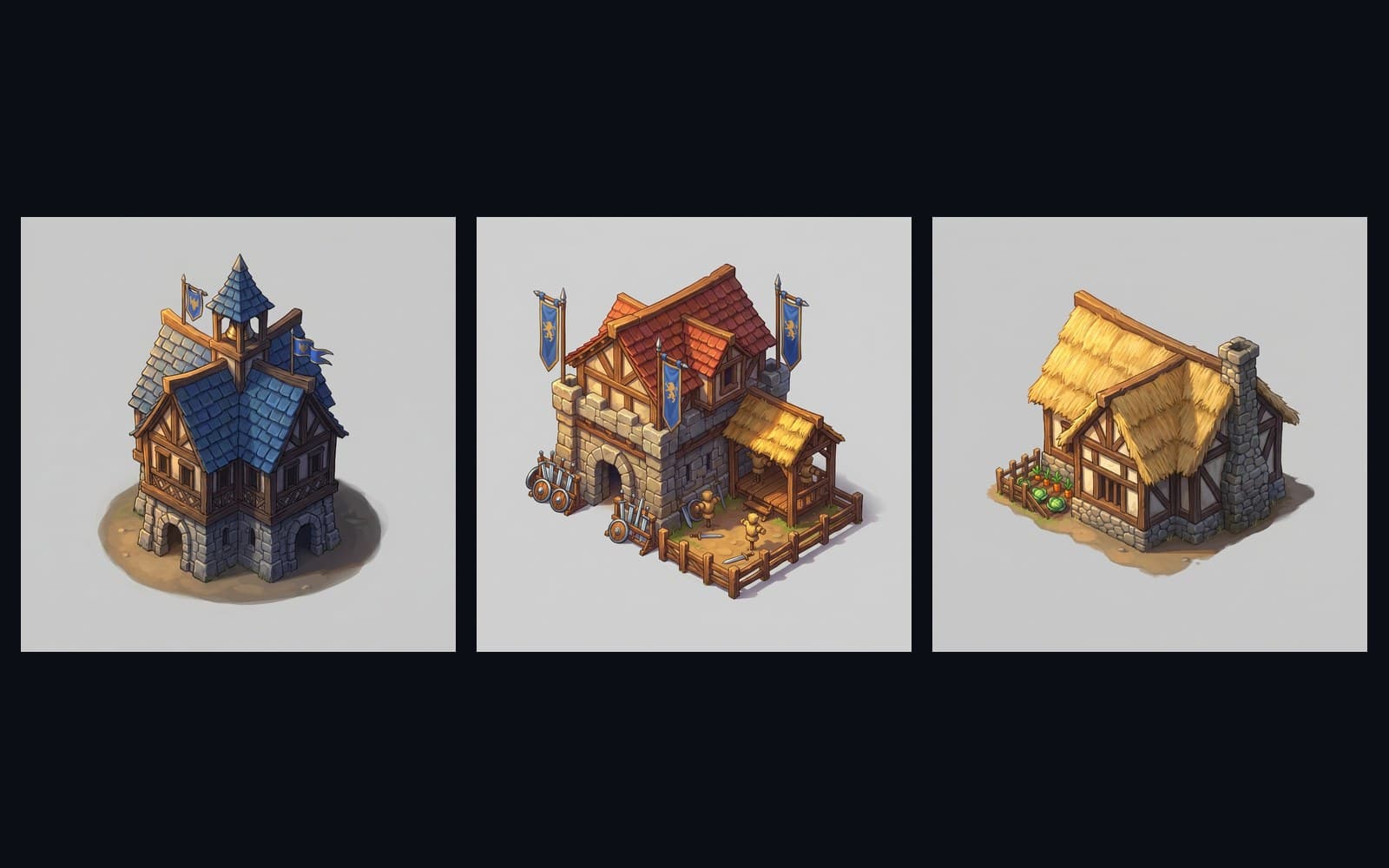
The Forge · creation: concept renders of buildings generated by the pipeline.
Pentest audit with a ready report
The system runs non-destructive testing and assembles a professional report itself: executive summary, OWASP findings table, severities and remediations. Below are two real reports; the audited target's name and links are redacted.
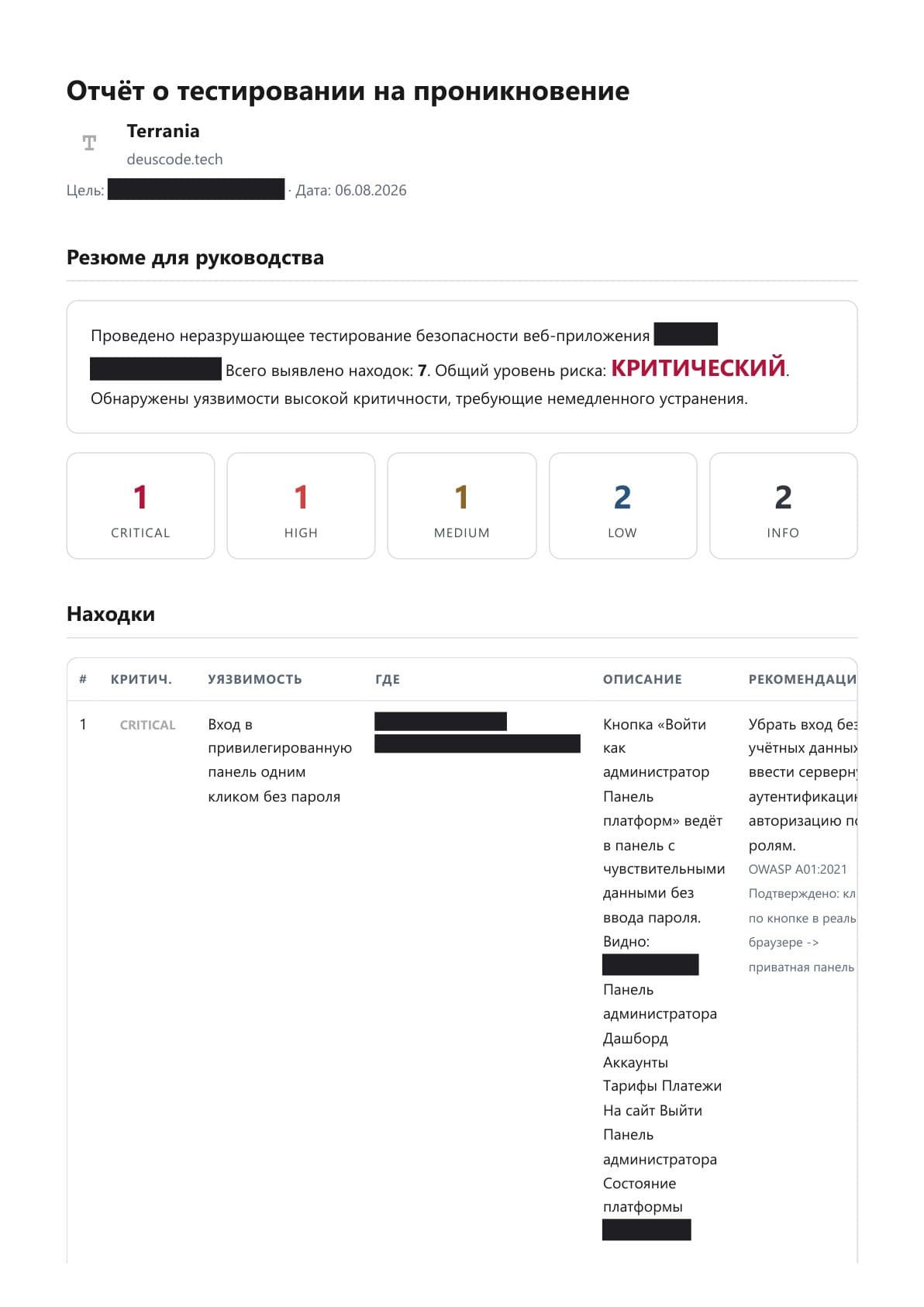
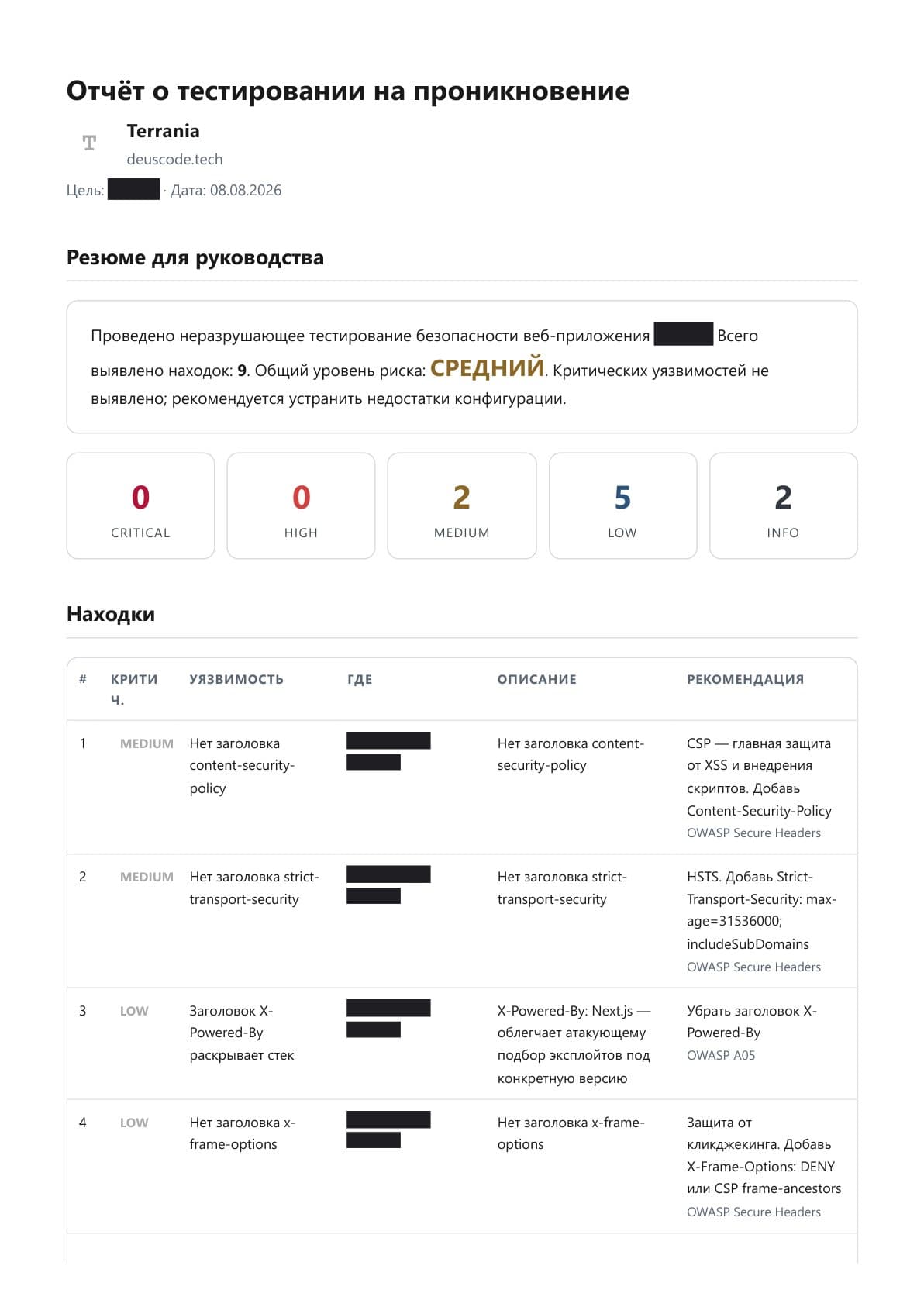
Both reports are anonymized: the audited target's name and addresses are redacted, the auditor's signature (Terrania · deuscode.tech) is kept. This is a capability demo, not client disclosure.
Round & equity calculator
The price is fixed: $1,300,000 per 1%. Entry from 0.2% ($260,000) to 30% ($39M), in 0.2% steps — every cheque is a round multiple of $260,000. Move the slider to see your cheque, yearly profit share, multiple and payback. These are models on stated assumptions, not a guarantee.
The stake is lifetime, paid from the project's net profit. The $130M valuation is fixed by the per-percent price; several investors can join the round.
What the stake earns per year — by scenario
The model: local models keep variable costs low, net margin ≈50%. The $130M valuation is aggressive — see the risks block.
⏱ Counted from month 6: the product works, but scaling infrastructure and the enterprise go-to-market take time to steady revenue.
Scenarios are the yearly run-rate of the FULL round's ad machine: of the $39M, half ($19.5M) goes to advertising. CAC is the modelled cost of acquiring one paying subscriber; ARPU $20–25/mo; margin ≈50%. The machine is shared: 50% of every incoming cheque adds fuel for all shareholders, so the scenarios do not depend on your stake size. If the round closes partially, the machine scales down proportionally. These are models, not a guarantee.
Where the money goes: 50% of the round is advertising
Every percent sold is not just a stake — it is an ad budget that brings audience to all shareholders at once.
50% into ads, 50% into the product
Every 0.2% sold ($260k) splits in half: one half goes into ad campaigns from month one, the other into infrastructure and product development.
The trial funnel
Ads bring users to a free trial with reduced capabilities; the system's own functionality sells the upgrade. The model: a meaningful share of trial users converts to a subscription from $20.
A worked example: the full round
With the full $39M round, $19.5M goes into ads. In the base scenario (CAC $10) that is ≈1.95M paying subscriptions and ≈$468M ARR: a 1% share of net profit (≈50% margin) earns ≈$2.3M a year — 10x on the cheque in roughly 6 years. The cautious and strong scenarios are on the slider above.
Every new investor strengthens everyone
When the next investor buys in, 50% of their cheque again goes into ads and brings new users to a finished product. The audience and the profit grow for all shareholders at once.
The pace benchmark is Cursor: ~$100M ARR by the end of 2024, $1B ARR by November 2025 (a $29.3B valuation), ~$3–4B ARR by mid-2026 — while running at a loss on paid models. Terrania runs on free models and P2P and keeps a ≈50% margin.
Key metrics
The reference points the round model is built on.
Across 16 domains — from the console to 3D and shipping games.
Entry · pro · enterprise/pentest per month.
Models run on your hardware — data never hits the cloud.
Low variable cost thanks to local models.
Risks — plainly, unsoftened
⚠Valuation risk
Risk: $130M post-money is a high bar for the stage; slow scaling stretches the return. This is the deal's main risk.
How we solve it: The P2P architecture grows power with the user count without giant hosting costs; 50% of every cheque goes to work in ads immediately; the roadmap targets the top of the field. It is a bet on execution — and we say so plainly.
⚠Regulatory / content
Risk: The uncensored mode and the adult segment are sensitive to regulation; AI-media rules keep changing.
How we solve it: Mandatory KYC for the verified segment, a censored open tier, jurisdiction control and legal support for the segment.
⚠Security dual-use
Risk: The pentest capability is powerful — a risk of unauthorized use.
How we solve it: Sold only into authorized, contracted engagements: contract, scope, system-owner confirmation; reports follow the OWASP standard.
⚠Hardware dependency
Risk: Local-model performance depends on the operator's hardware; the max tier needs an external key.
How we solve it: Model profiles for weak and strong hardware (fast/free/code), the P2P network adds power, and max is an option, not a requirement.
⚠These are models
Risk: Projections rest on stated assumptions, not booked revenue.
How we solve it: We repeat this next to every figure; the assumptions are named on the page and the AI consultant must state them.
Enter Terrania
A working agentic AI system for enterprise and pentest. A lifetime share of net profit, entry from 1%. The round funds scale, infrastructure and the enterprise push.
All financial figures are models based on stated assumptions, not a promise of returns. Investment carries the risk of total loss. Content-generation features are provided in a legal segment with mandatory KYC verification. This material is informational and is not a public offer or investment advice.