
CRM for small business in Kazakhstan and Central Asia 2026: stop losing leads from WhatsApp and Instagram
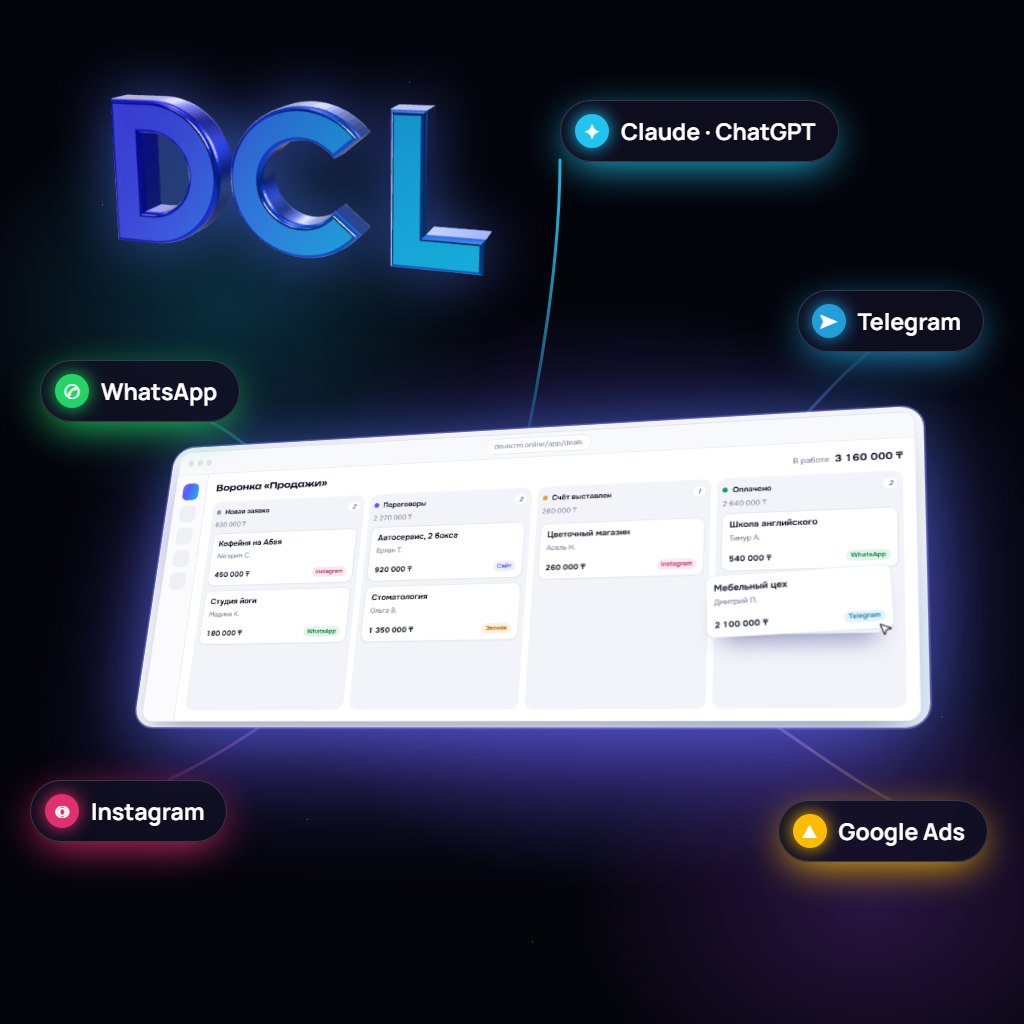
Monday morning. A sales manager has 40 unread chats in WhatsApp, 15 more in Instagram Direct, two website requests in the mailbox, and the client who asked for an invoice on Friday has already bought from a competitor. Nobody is to blame: leads simply live in five places at once, and none of them reminds anyone who has to answer and when.
That is exactly the problem a CRM solves. This guide skips the theory and covers what a CRM for a small company in Kazakhstan and Central Asia should do in 2026, how to connect WhatsApp and Instagram, why a CRM now needs AI, and how to launch it in one day rather than three months.
Where the money actually leaks
Small businesses rarely lose clients because of a bad product. More often a lead was not seen, got an answer a day later or nobody called back. The typical leaks:
- Managers' personal phones. The conversation lives in an employee's WhatsApp. When the employee leaves, the client base leaves too.
- Instagram Direct. Messages from ads and stories mix with personal chats and get buried.
- Website requests by email. The email was read, no task was created, and a week later nobody remembers it.
- No stages. The owner cannot see how many deals are stuck at "proposal sent" and why.
A simple example: with 10 leads a day, an average deal of $300 and every fifth lead lost, about 60 leads leak out of the pipeline every month. Even if only a third of them would have bought, that is $6,000 of revenue the business never saw.
A CRM is not about reports. It makes sure every lead gets an owner, a deadline and a next step.
What a small-business CRM must do in 2026
1. Leads arrive on their own
The key criterion. If a manager copies leads from WhatsApp into the CRM by hand, they will stop doing it within a week. The system should accept requests from WhatsApp (the official WhatsApp Business Platform or services like Wazzup and Green API), Instagram Direct, website forms including Tilda and WordPress, Facebook, Instagram and Google Ads lead forms, and quizzes or other tools through a webhook.
2. A kanban pipeline anyone gets in a minute
Deals as cards across stages: "New lead", "Contacted", "Invoice sent", "Paid". Drag a card and the stage changes. If an employee cannot understand the interface in a minute, they will work around the system.
3. Phone and Telegram first
In Kazakhstan and the wider region sales happen on the phone. A CRM should work properly on a smartphone, send alerts about new leads and ideally run right inside Telegram as a Mini App, so nobody has to install anything.
4. Tasks and reminders
Every deal needs a next step with a date. The system reminds the manager and shows the owner overdue tasks.
5. Analytics without spreadsheets
Revenue by month, funnel by stage, conversion, lead sources and results per manager, right in the CRM.
6. 1C, telephony and API
If accounting runs in 1C and calls go through VoIP (Zadarma, Mango Office, Sipuni, Binotel, UIS, Asterisk), the CRM must exchange data with them. Everything else needs a REST API and webhooks.
7. Language
Teams in Kazakhstan need Russian and Kazakh, and English for international partners.
8. Security and data safety
Two-factor sign-in, roles, an activity log, encrypted integration keys and isolated company data. Ask one more question before buying: what happens to your data if you stop paying? The right answer: nothing is deleted and you can export everything.
9. A price per company, not per seat
Many large CRMs charge for every user. For a team of 3 to 7 people that adds up quickly. Look for plans priced per company.
Connecting WhatsApp to a CRM: three ways
| Option | How it works | Best for |
|---|---|---|
| WhatsApp Business Platform (Cloud API) | Official Meta channel, the number is connected through a business account | Companies that need an official, scalable channel |
| Wazzup | A regular WhatsApp number connected by QR code, plus Instagram and Telegram | Small businesses that want to start today |
| Green API | A regular WhatsApp number connected through an intermediary service | A quick, low-cost start |
AI in the CRM: an assistant for the owner, not a chatbot
In 2026 there is a new way to work with a CRM: connect an AI assistant to it. The open MCP (Model Context Protocol) lets Claude, ChatGPT and other assistants access CRM data with a specific user's permissions. The owner simply writes: "Which deals have been stuck for more than a week?", "Ask the managers to call them back tomorrow at 11:00", "Build a sales report for October and compare it with September". The assistant finds the data, creates tasks and builds the report. Access goes through OAuth, actions are logged, the AI only sees your company, and it has no delete tools.
A one-day rollout plan
- Sign up and set up pipeline stages around your sales process.
- Import clients from Excel or your old CRM.
- Connect WhatsApp, Instagram and the website form, send a test lead.
- Invite the team by email and assign roles.
- Everyone links the Telegram bot to get lead alerts.
- In the evening the owner sees the first pipeline, and a week later sees where the money gets stuck.
Example: DeusCRM Light
DeusCode built its own CRM for small businesses and sales teams, DeusCRM Light (DCL), around exactly this checklist: a kanban pipeline, contacts, tasks, calls and analytics; leads from WhatsApp, Instagram Direct, Meta and Google Ads lead forms, websites, Tilda and WordPress; a Telegram bot in three languages and a Mini App; Claude, ChatGPT, Claude Code and Cursor over MCP; 1C, VoIP, REST API and webhooks; an interface in Russian, Kazakh and English.
Pricing is per company: Solo $10 a month for one person, Team $24 for up to 5 users, Business $39 with 7 users included and $6 for each extra one. Pay quarterly and save 10%, yearly and save 20%. The first 7 days are free, no card needed.
Try it at deuscrm.online and read the full product overview on the DeusCRM Light page.
When you need your own CRM
A ready CRM covers most small-business needs. A custom system makes sense for non-standard processes: made-to-order production, complex pricing, your own warehouse or special data-residency requirements. Then we build a CRM around the company's process, often on top of DCL so you do not pay to rebuild what already works. We send a fixed estimate in PDF after a short brief.
Related articles
How to tell a strong software studio from one stuck in 2010: live projects, a fixed estimate, a modern stack, AI and messenger expertise, security and code ownership. Questions to ask before you sign.
StreamingYour own Netflix for a niche is realistic. What a streaming platform consists of, what VOD and live streaming cost to launch, and why traffic economics decides everything.
SEOCustomers increasingly ask AI instead of search. A practical 2026 guide to AI SEO: llms.txt, structured data, external mentions, and what to do so neural networks recommend your business.
SocialA breakdown by DeusCode's social platforms lead: when building your own social network makes sense, what it costs, which architecture survives growth, and what usually kills these projects.